Business Continuity and Outage Prevention: Why Network Resilience Is Now an Operational Requirement
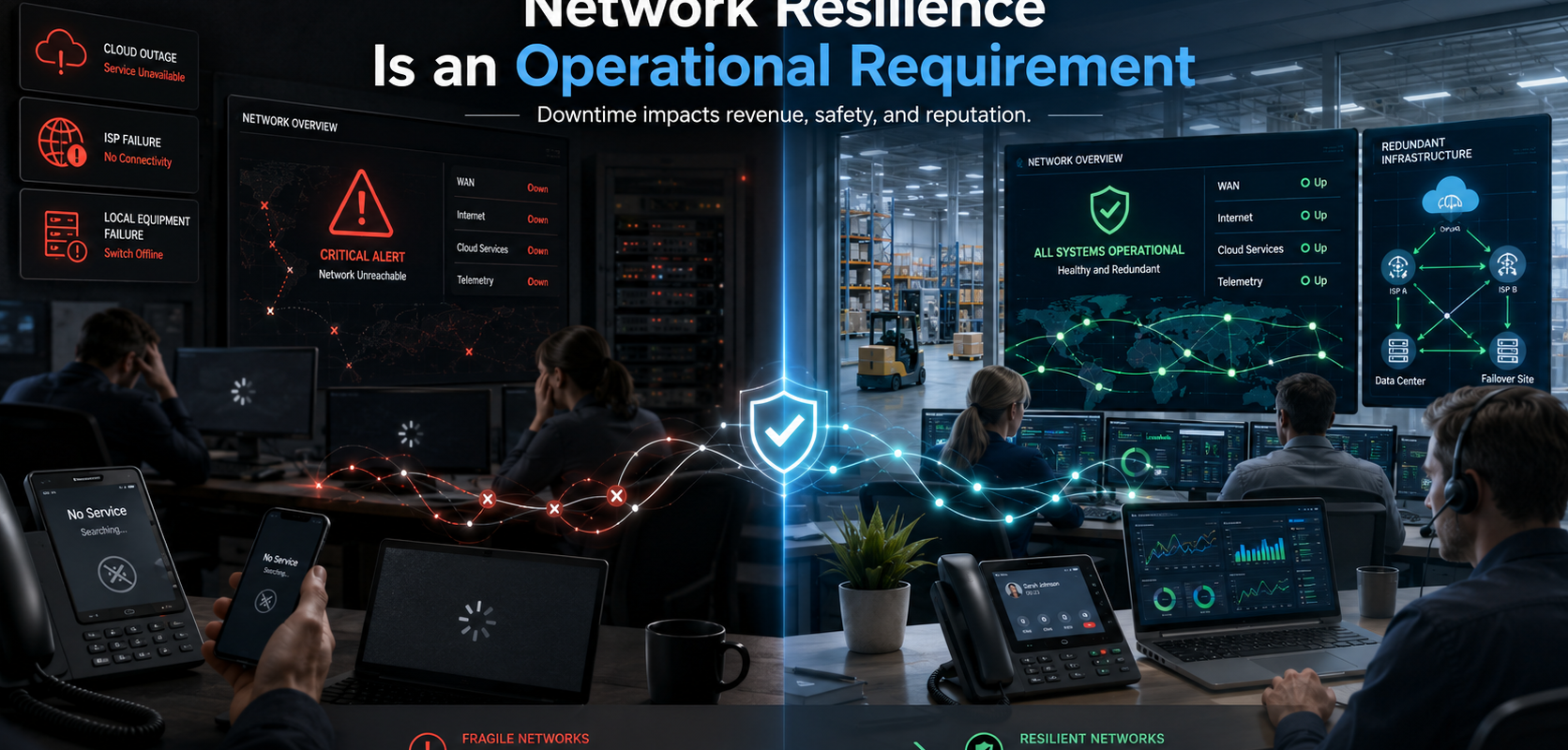
Downtime Is Not a Technology Problem. It Is a Revenue, Safety, and Reputation Problem.
Cloud platforms go down. Internet service providers experience disruptions. Local switches, cabling, power supplies, radios, servers, and endpoints fail. None of this is new.
What has changed is the impact.
Today, nearly every operational system depends on a reliable network foundation. Phones, paging, public address systems, access control, video, building management systems, wireless links, cloud applications, metering systems, and critical communications all rely on the same thing: connectivity that works when people need it most.
That is why business continuity is no longer just an IT department topic. It is an operations topic. A safety topic. A customer experience topic. A leadership topic.
Recent industry research from Splunk and Cisco found that unplanned downtime has become a major business risk, with Global 2000 companies losing an estimated $600 billion annually to outages and service degradation. The same research reported an average downtime cost of $15,000 per minute for large organizations.
For Michigan municipalities, manufacturers, utilities, healthcare facilities, schools, transportation environments, and commercial campuses, the message is clear:
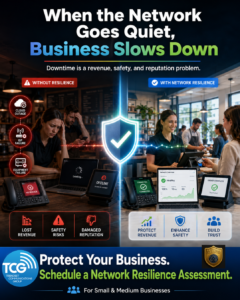
Downtime is not simply inconvenient. It can stop work, delay service, compromise safety, damage trust, and create costs that reach far beyond the repair ticket.
At Trendset Communications Group, LLC, we help organizations reduce that risk by designing, installing, maintaining, and supporting the physical and communications infrastructure that keeps facilities connected. From structured cabling and fiber optics to wireless networks, public address and paging systems, private LTE, AV, access control, and 24/7 ServicePAK support, TCG focuses on the layers of infrastructure that many organizations only think about after something fails.
The New Reality: Your Network Has More Failure Points Than Ever
A modern facility does not depend on one connection or one closet anymore.
It may depend on:
Cloud-hosted business applications
ISP circuits and carrier handoffs
Fiber backbones between buildings
Network switches and patch panels
Wireless bridges and outdoor radios
Paging and public address endpoints
Security and access control devices
Building automation systems
Cameras, displays, and AV systems
Backup power and UPS equipment
Remote monitoring and support platforms
Every one of these layers can become a point of failure.
That does not mean outages are always avoidable. Even well-built systems can face carrier issues, power events, weather damage, hardware failure, configuration errors, or aging infrastructure. However, the difference between a brief disruption and a full operational shutdown often comes down to planning.
Resilient organizations ask better questions before something breaks:
What happens if our primary ISP fails?
What systems stop working if a switch goes down?
Can emergency messages still be delivered?
Do we have tested fiber paths, documented cabling, and labeled network closets?
Who answers the phone when something fails after hours?
Are our warranties, RMAs, and replacement processes ready before we need them?
If the answer is “we’ll figure it out when it happens,” the business continuity plan is already behind.
Outage Prevention Starts With the Physical Layer
There is a reason TCG talks so much about structured cabling, fiber optics, labeling, testing, and certified installation.
The network is only as reliable as the infrastructure beneath it.
Cloud systems may get the headlines, but local infrastructure often determines whether a facility can keep operating during an incident. A poorly terminated cable, unlabeled patch panel, overloaded network closet, damaged fiber strand, or undocumented wireless link can turn a small problem into hours of troubleshooting.
That is why outage prevention begins with fundamentals:
Clean, certified structured cabling
Properly tested fiber optic backbones
Documented pathways and labeling
Redundant network paths where possible
Industrial-grade equipment for harsh environments
Correct grounding, protection, and enclosure practices
Routine inspection of closets, racks, and field devices
Clear separation of critical systems from non-critical traffic
Good infrastructure does not make noise when it works. It simply keeps the building moving.
Bad infrastructure usually announces itself at the worst possible time.
Business Continuity Is Also a Safety Issue
For many organizations, downtime is not just about lost productivity. It can affect life safety and situational awareness.
If a paging system fails in a school, airport, plant, utility facility, or public building, emergency communication becomes harder. If access control or camera systems lose connectivity, security teams lose visibility. If a building management system cannot communicate, facility teams may lose control over alarms, environmental conditions, or operational data.
The Uptime Institute’s 2025 outage analysis notes that while infrastructure design has improved, modern architectures and external threats have introduced risks that operators must actively manage.
That is exactly where proactive infrastructure planning matters. Critical systems should be reviewed as connected ecosystems, not isolated devices.
A paging system is not “just audio.” It depends on network switches, cabling, endpoints, controllers, software, power, configuration, and support. A wireless link is not “just internet.” It may be the connection between buildings, departments, cameras, meters, or operations teams. A fiber backbone is not “just cable.” It may be the path every critical system uses to communicate.
When continuity matters, every layer matters.
The Cost of Waiting Until Something Breaks
Reactive service always feels cheaper until the outage happens.
Then the real costs arrive:
Idle employees
Missed production windows
Delayed customer service
Emergency labor premiums
Expedited replacement equipment
Lost sales or service revenue
Frustrated residents, passengers, patients, or customers
Reputation damage
Safety exposure
Leadership distraction
And the problem is not always fixed when the lights turn green again. Organizations may spend days or weeks rebuilding confidence, explaining what happened, and trying to prevent a repeat incident.
That is why TCG’s position is simple:
The best outage response starts before the outage.
What an Outage Prevention Plan Should Include
A strong business continuity and outage prevention strategy should include both technical design and operational readiness.
1. Infrastructure Assessment
Start with a site review of network closets, cabling, fiber, wireless links, racks, pathways, paging equipment, power protection, and documentation. Many outage risks are visible before they become emergencies.
2. Critical System Mapping
Identify which systems are mission-critical and what they depend on. This may include phones, paging, PA, access control, video, AV, building management, metering, production systems, or cloud access.
3. Redundancy Planning
Where downtime is unacceptable, redundancy should be intentional. That may include secondary ISP paths, backup fiber routes, wireless failover, spare hardware, UPS protection, or alternate communication methods.
4. Preventive Maintenance
Routine inspections help catch failing equipment, messy closets, damaged cables, outdated firmware, weak wireless signals, and environmental issues before they cause outages.
5. Documentation and Labeling
During an emergency, no one wants to guess which cable feeds the paging headend or which fiber strand connects Building B. Accurate documentation reduces troubleshooting time.
6. Warranty and RMA Readiness
Critical systems should have a clear process for replacement parts, warranty claims, and manufacturer support. TCG’s ServicePAK offering includes support for repair, emergency service, and RMA warranty needs for critical communications infrastructure.
7. 24/7 Support Coverage
Outages do not respect business hours. TCG’s ServicePAK program provides 24/7 emergency response, priority support, and direct access for covered clients when something breaks outside the normal workday.
Why Michigan Organizations Choose TCG
Trendset Communications Group is a Clinton Township-based systems integration firm serving Michigan businesses, municipalities, utilities, schools, healthcare environments, transportation facilities, and commercial campuses. TCG provides structured cabling, fiber optic networking, wireless networks, private LTE, public address and paging systems, audio-visual systems, access control, AMI/AMR installation, and ServicePAK 24/7 support.
TCG is also a WBE-certified Michigan systems integrator with more than 15 years of experience, a manufacturer-certified technical team, and a lifetime craftsmanship guarantee on TCG installations.
That combination matters because business continuity is not solved by one product. It requires field experience, certified installation, practical design, responsive service, and a team that understands how facilities actually operate.
Build Resilience Before the Next Outage
Cloud outages, ISP failures, and local equipment failures will continue to happen. The question is not whether every risk can be eliminated. It cannot.
The better question is this:
When something fails, will your organization bend or break?
A resilient infrastructure plan helps your team keep communicating, keep operating, and recover faster. It reduces surprises. It protects revenue. It supports safety. It preserves trust.
And in today’s connected facilities, that is not an IT luxury.
It is an operational requirement.
Ready to Strengthen Your Continuity Plan?
Trendset Communications Group can review your current infrastructure, identify outage risks, and recommend practical improvements for network resilience, emergency communications, paging, structured cabling, fiber, wireless, and ServicePAK support.
Talk to a Michigan-based TCG expert today.
Call 586-765-0770 or request a free project estimate through tcgexperts.com.
Ready to talk to a Michigan communications expert?
Get a Free Estimate