Michigan Emergency Communications, Paging & ERRCS Planning | TCG
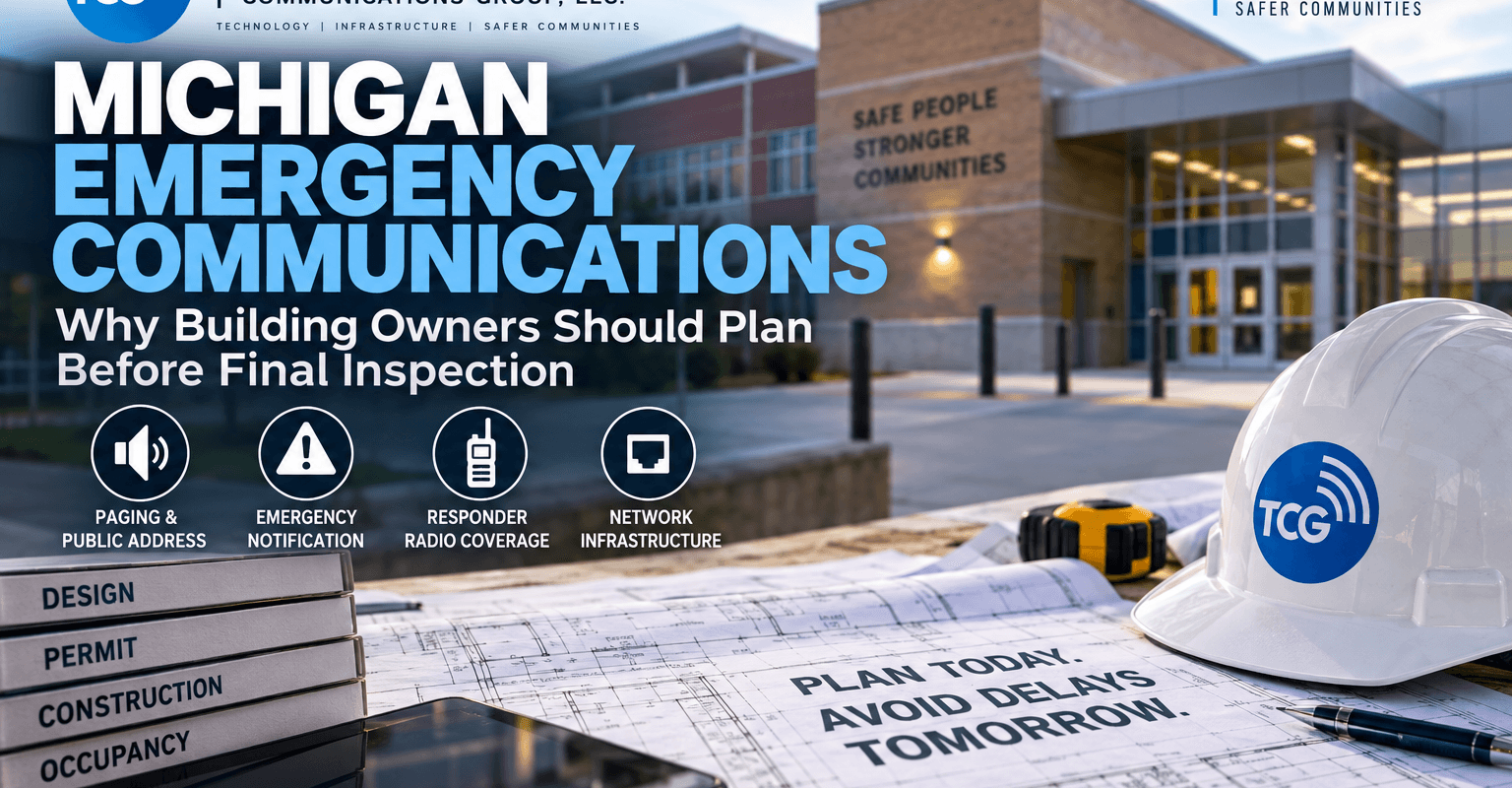
Emergency Communications Should Be Part of the Building Plan — Not a Final-Inspection Surprise
One of the most expensive statements that can be made during a construction or renovation project is:
“We’ll deal with radio coverage at final inspection.”
By that point, the building may be substantially complete, budgets may already be committed, ceilings may be closed, network infrastructure may be installed, and occupancy deadlines may be approaching.
Discovering an emergency communications or in-building public-safety radio coverage issue at that stage can create unnecessary delays, additional construction costs, redesign work, and difficult conversations between owners, contractors, engineers, inspectors, and Authorities Having Jurisdiction (AHJs).
At Trendset Communications Group, LLC. (TCG), we believe emergency communications infrastructure should be evaluated much earlier in the project lifecycle.
For Michigan schools, municipalities, commercial facilities, and other public buildings, three areas deserve particular attention:
Emergency notification and mass communication
Building paging and public-address systems
In-building emergency responder radio coverage
While these systems perform different technical functions, they ultimately support the same mission:
Can building occupants receive and understand an emergency message, and can first responders communicate effectively once they enter the building?
1. Michigan Schools May Have a Funding Path for Emergency Communications
Michigan’s FY2026 Section 31aa allowable-use guidance identifies “emergency response system” and “safety infrastructure” among allowable expenditure categories.
That creates an important opportunity for eligible Michigan school districts.
The first step should not necessarily be selecting equipment. Instead, districts should determine where their existing communications infrastructure has deficiencies and then determine whether those needs align with available funding requirements.
That assessment could include reviewing:
Existing building paging coverage
Emergency notification capabilities
Classroom and common-area intelligibility
Outdoor notification coverage
Integration between paging and emergency systems
Network infrastructure supporting IP-based communications
Emergency responder radio coverage
Communications coverage in stairwells, mechanical areas, basements, and other difficult RF environments
System redundancy and backup power
Existing equipment lifecycle and obsolescence
Importantly, the availability of funding should not be interpreted to mean that every paging, ERRCS, radio, or communications project automatically qualifies.
Eligibility should be verified against the applicable Michigan Department of Education requirements before expenditures are committed.
The bigger strategic opportunity is this:
Schools should map their communications and life-safety gaps first, then determine which available funding mechanisms can appropriately address them.
2. Michigan Has Not Enacted Alyssa’s Law — But Schools Don’t Have to Wait for a Mandate
As of the material reviewed for this article, Michigan is not among the states that have enacted Alyssa’s Law.
That distinction matters.
Without a statewide Alyssa’s Law mandate, Michigan schools may not face the same statutory deadline pressure found in states where specific emergency notification capabilities have been legislatively required.
But lack of a mandate should not be confused with lack of need.
Forward-thinking districts can evaluate emergency communications infrastructure based on operational requirements rather than waiting until legislation forces the issue.
School administrators and facility teams should be asking questions such as:
Can an emergency announcement actually be heard and understood throughout the building?
Can staff quickly initiate the appropriate notification?
Are cafeterias, gymnasiums, auditoriums, mechanical spaces, outdoor areas, and other difficult environments adequately covered?
Can emergency messages be distributed through multiple communications channels?
Can police, fire, EMS, and other first responders maintain radio communications after entering the facility?
These are operational questions—not simply technology questions.
3. ERRCS and Public-Safety Radio Coverage Need to Be Addressed Early
Modern commercial buildings can create extremely challenging RF environments.
Concrete, structural steel, energy-efficient glass, metal roofing, underground areas, stairwells, elevators, mechanical rooms, and other building materials can significantly affect radio propagation.
A radio signal that works perfectly outside a building may perform very differently once a responder moves deep inside the structure.
That is why Emergency Responder Radio Communication Systems (ERRCS/ERCES) and in-building public-safety radio coverage need to be considered during project planning.
In Michigan, these requirements can be influenced by the local Authority Having Jurisdiction rather than a single statewide ERRCS mandate.
Projects may also involve coordination and consent requirements associated with the Michigan Public Safety Communications System (MPSCS) licensee.
That coordination is important because ERRCS is not simply a matter of installing a signal booster and antennas.
A properly engineered solution may involve:
RF coverage assessment
Public-safety frequency analysis
Donor antenna design
Bi-Directional Amplifier (BDA) or signal-booster engineering
Distributed Antenna System (DAS) design
RF isolation calculations
Cable-loss calculations
Battery backup
Monitoring and alarming
Equipment survivability
Pathway considerations
AHJ coordination
Licensee approval
Acceptance testing and documentation
Trying to address all of these requirements shortly before a Certificate of Occupancy can create substantial project risk.
Paging, Emergency Notification and Responder Radio Are Part of One Communications Strategy
Organizations often treat these systems as separate projects.
The paging system belongs to facilities.
The network belongs to IT.
The fire alarm belongs to another contractor.
The radio system belongs to public safety.
The emergency notification platform may belong to security.
From an organizational chart perspective, that separation may make sense.
From an emergency response perspective, however, it doesn’t.
During an actual emergency, the building needs a coordinated communications strategy.
The fundamental questions are simple:
Can people hear the warning?
Can they understand the instructions?
Can authorized personnel initiate the appropriate message quickly?
Can first responders communicate once they enter the building?
Will the communications infrastructure continue operating when normal conditions deteriorate?
That is the bigger picture.
The Permit-Stage Gap
One of the most preventable mistakes in communications infrastructure planning is waiting until late in construction to evaluate emergency communications requirements.
By that point, the project may already have:
Completed architectural design
Established construction budgets
Selected major subcontractors
Installed ceilings
Completed telecommunications pathways
Installed network infrastructure
Finished electrical work
Established occupancy dates
If a communications deficiency is discovered late, solving it becomes considerably more complicated.
A better approach is to evaluate communications requirements during the planning, design, budgeting, renovation, or permitting stages whenever possible.
That gives owners, engineers, architects, contractors, IT departments, security teams, and public-safety stakeholders an opportunity to identify requirements before they become expensive change orders.
A Better Approach: Start With an On-Site Communications Assessment
Before replacing equipment or designing an entirely new system, TCG recommends understanding the existing environment.
A professional communications assessment can evaluate several infrastructure layers simultaneously.
Building Paging & Public Address
Evaluate whether announcements are audible and intelligible throughout required areas of the facility.
Emergency Notification
Determine how emergency messages are initiated, distributed, prioritized, and integrated with existing communications infrastructure.
Network Infrastructure
Review the Ethernet, fiber-optic, structured cabling, PoE, switching, VLAN, and network infrastructure supporting IP-based communications.
Public-Safety Radio Coverage
Evaluate whether building construction or RF conditions could create communication challenges for first responders.
Backup Power & Resiliency
Determine whether critical communications equipment can continue operating during a commercial power interruption.
System Integration
Identify opportunities for paging, networking, emergency notification, fire alarm interfaces, public-safety communications, and other building technologies to operate as a more coordinated infrastructure platform.
Don’t Start With Equipment — Start With the Requirement
TCG’s approach is straightforward.
We don’t believe the first question should be:
“What equipment should we buy?”
The first question should be:
“What does this building need to accomplish?”
Once the operational requirement is understood, the appropriate technology can be engineered around it.
That approach can help organizations avoid unnecessary equipment replacement, identify existing infrastructure that can be reused, prioritize the most significant deficiencies, and develop phased capital-improvement plans.
For schools and municipalities operating under tight budgets, that distinction can be significant.
Plan Before the Problem Becomes an Emergency
Michigan schools, municipalities, commercial property owners, construction teams, and facility managers have an opportunity to become more proactive about communications infrastructure.
Don’t wait until final inspection.
Don’t wait until an inspector identifies a coverage problem.
Don’t wait until an aging paging system fails during an important announcement.
And don’t wait for legislation to force improvements that already make operational sense.
Evaluate the building. Identify the gaps. Establish the requirements. Build the roadmap.
That is a far more manageable process than discovering critical communications deficiencies at the end of a project.
Schedule a TCG Communications Infrastructure Assessment
Trendset Communications Group, LLC. works with organizations throughout Southeast Michigan to evaluate, engineer, install, integrate, test, and support critical communications infrastructure.
Our capabilities include:
Building Paging & Public Address
Mass Notification
Emergency Communications
ERRCS / ERCES & In-Building Public-Safety Communications
Professional Audio Systems
Structured Cabling Solutions
Fiber-Optic Infrastructure
Ethernet & Network Infrastructure
Wireless Communications
Backup Power & Communications Resiliency
System Testing, Documentation & Preventive Maintenance
If you’re responsible for a Michigan school, municipal facility, commercial property, manufacturing facility, transportation facility, or other critical building and you’re uncertain about the condition of your communications infrastructure, start with an assessment rather than an equipment purchase.
Make TCG Part of Your Planning Process
Trendset Communications Group can perform an on-site evaluation of your existing communications infrastructure, identify potential coverage and operational gaps, and help establish a practical roadmap for improvements.
Funding, code requirements, technology selection, or simply not knowing where to start shouldn’t prevent the conversation.
Start by understanding where your facility stands today.
Trendset Communications Group, LLC.
First in Class Infrastructure.
Serving Southeast Michigan with professional communications, networking, structured cabling, paging, public-safety communications, and technology infrastructure solutions.
Ready to talk to a Michigan communications expert?
Get a Free Estimate